
Convert Hijri to Gregorian
Turn a Hijri year, month and day into its Gregorian calendar date using the country settings selected above.
Calculation basis: Saudi Arabia (Umm al-Qura) Asia/Riyadh updated at 00:00 local time
Calculation basis
Selected basis: Saudi Arabia (Umm al-Qura) · Asia/Riyadh · adjustment 0
Selected result
21 Jumada al-Ula 1448 AH
Sunday, 1 November 2026
Official announcementObserved data is incomplete; this month uses provisional month starts and may differ by ±1 day.
Some country settings are provisional while official data is reviewed.
The civil date changes at midnight; religiously, the new day begins at sunset.
Switching here updates the date card, tools and month calendar in your browser. The H1 stays fixed, and no URL or query parameter changes. The country comparison table keeps the dates from when the page was published.
Enter the Hijri date; the Gregorian date updates in place. The inverse uses the same method and adjustment as gregorian-to-Hijri conversion.
Result
Sunday, 1 November 2026
21 Jumada al-Ula 1448 AH
Official announcementUses the country and calendar selected above.
The first day of every month this Hijri year
A quick reference for 1448 AH, calculated with Saudi Arabia · Umm al-Qura.
| Hijri month | First day (Gregorian) | Length |
|---|---|---|
| Muharram | Tuesday, 16 June 2026 | 29 days |
| Safar | Wednesday, 15 July 2026 | 30 days |
| Rabi al-Awwal | Friday, 14 August 2026 | |
| Rabi al-Thani | Saturday, 12 September 2026 | |
| Jumada al-Ula | Monday, 12 October 2026 | |
| Jumada al-Akhirah | Wednesday, 11 November 2026 | |
| Rajab | Thursday, 10 December 2026 | |
| Shaban | Saturday, 9 January 2027 | |
| Ramadan | Monday, 8 February 2027 | |
| Shawwal | Tuesday, 9 March 2027 | |
| Dhu al-Qadah | Thursday, 8 April 2027 | |
| Dhu al-Hijjah | Friday, 7 May 2027 |
These dates follow the selected country settings on the day this page was published. Local sighting can still differ by a day.
Why the exact date needs a calendar table
An arithmetic approximation treats years as a repeating pattern. Real calendars determine each month from tables or sightings, so month lengths and year lengths vary. Converting in the other direction uses a search through those calendar tables, which is why this tool can keep the same method, time zone and manual adjustment in both directions.
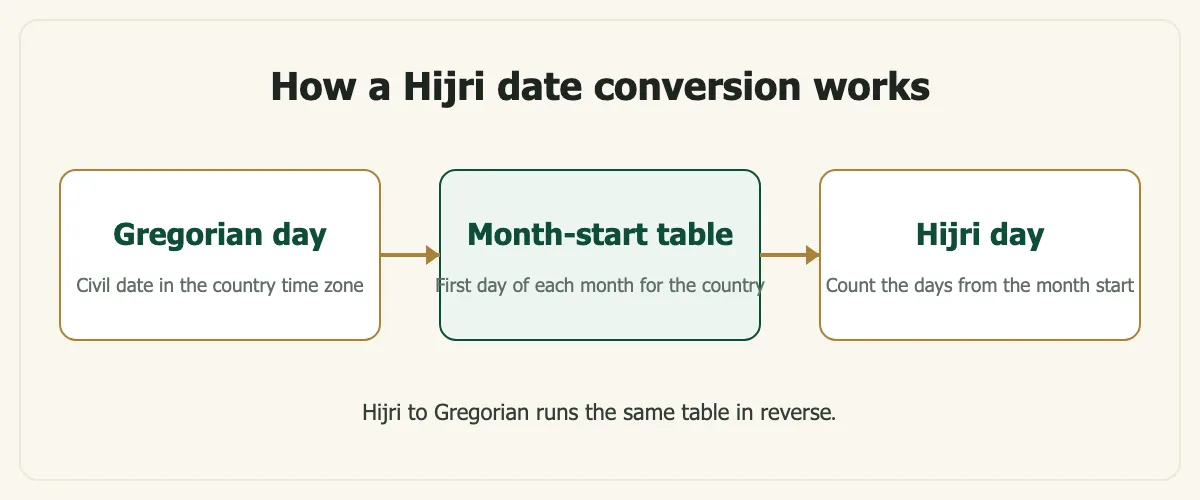
Hijri to Gregorian conversion, step by step
To convert Hijri to Gregorian, start with the country whose month starts you trust. The tool looks up the first day of the Hijri month, adds the day number, then reads the matching civil date in that country's time zone.
This is why a Hijri to Gregorian result can differ by one day between two selectors even when the Hijri input is identical. The table, not an average year length, supplies the month start.
Convert Hijri to Gregorian: 1448 AH examples
For the current default table, 1 Ramadan 1448 AH is 8 February 2027, and 1 Shawwal 1448 AH is 9 March 2027. Read them as complete dates, not as the approximate Gregorian year produced by the formula above.
Hijri date to Gregorian: why the table matters
A Hijri year is about 354 or 355 days, so the same Hijri month moves earlier through the Gregorian year over time. Month lengths alternate, and authorities can begin a month on different days. A table-backed Hijri to Gregorian conversion keeps the month start visible; a Hijri date to Gregorian conversion that ignores those tables can be off by a day or more.
Hijri to Gregorian converter tips
Check the basis line before copying a result. Use the same country when comparing two dates, and open the 1448 AH calendar to review month starts and observances. If you need both directions in one form, use the full converter; the Hijri to Gregorian direction here stays focused on one exact answer.
Open the Hijri date converterOpen the Hijri calendar 1448 AH
Hijri to Gregorian conversion: frequently asked questions
How do I convert a Hijri date to Gregorian?
Enter the Hijri year, month and day in the tool above, and the Gregorian date appears with its weekday. The tool looks up the first day of that Hijri month in the Saudi Arabia table, adds the day number minus one, and reads the civil date in that country's time zone. From the current table, 1 Ramadan falls on Monday, 8 February 2027 and 1 Shawwal on Tuesday, 9 March 2027, a typical Hijri to Gregorian lookup. If you enter day 30 of a month that has 29 days, the tool warns you, because that day does not exist in this table. When you follow another country's announcement, switch the country first, as the same month can begin one day later there. The quick formula shown on this page gives only an approximate Gregorian year; the exact day and month come from the table, which is why two dates entered here always share one basis.
What is the formula for converting a Hijri year to Gregorian?
For a Hijri to Gregorian year estimate, the usual approximation is G ≈ H × 0.970229 + 621.5643, where H is the Hijri year and G the approximate Gregorian year. It tells you which Gregorian year a Hijri year falls in, but it cannot give a day or a month.
Why is the formula not enough for an exact date?
The formula assumes a fixed average year length, while a Hijri month has 29 or 30 days and its start differs between countries. An estimate can be off by a day or more; the table gives each month start as it is.
What is the Gregorian date of Eid al-Fitr 1448 AH?
In the current Saudi Arabia table, 1 Shawwal, the day of Eid al-Fitr, is Tuesday, 9 March 2027. Countries that rely on a local sighting may mark it one day later, and the official announcement is the reference.
Why is my result one day off from a printed calendar or another site?
Usually because the other source uses a different country or calculation method, or the approximate formula. Check the basis line on this page, select the country the other source follows, and compare the two results again.
Does the Hijri day begin at sunset?
Yes, in Islamic law the Hijri day begins at sunset. This Hijri to Gregorian tool maps each Hijri date to one full civil day that starts at midnight, so the night of 1 Ramadan falls on the evening of the Gregorian day before the date shown.